Garment Tech Pack: What to Include (and What Usually Gets Missed)
A tech pack is the document that tells a factory what to make. It is not a mood board and not a folder of screenshots — it is a specification that a pattern maker, a fabric buyer and a sewing line can all work from without asking the same question three times.
Most first samples fail for a boring reason: a line was missing from the tech pack, so the sampling room filled the gap with a default. A measurement with no tolerance. A wash reference with no stated priority. A custom trim whose lead time was never counted.
This guide covers the six sections that actually carry the decisions, the gaps that appear most often, and what changes when the garment is denim rather than something else.
What a Tech Pack Actually Does
A tech pack is not a design document. It is a decision record, and it has three jobs.
It lets suppliers quote on the same basis. Two factories quoting from the same tech pack are pricing the same garment. Two factories quoting from a photo and a quantity are pricing two different guesses.
It lets the sample test the right question. If the tech pack states that the rise is fixed and only the leg is open, the sample is cut and reviewed accordingly. Without that line, the sampling room makes its own choice, and the review turns into an argument about something nobody decided.
It settles disagreements later. When bulk arrives and something looks different, the tech pack and the approved sample are the only two things that count. Everything else is memory.
The Six Sections That Carry the Decisions
1. Style Reference and Technical Drawings
Front and back flats, plus close-ups of any detail that is hard to read from the main drawing. Mark which features are fixed and which are open to adjustment — that single distinction prevents most of the avoidable sample rounds.
2. Measurements and Points of Measure
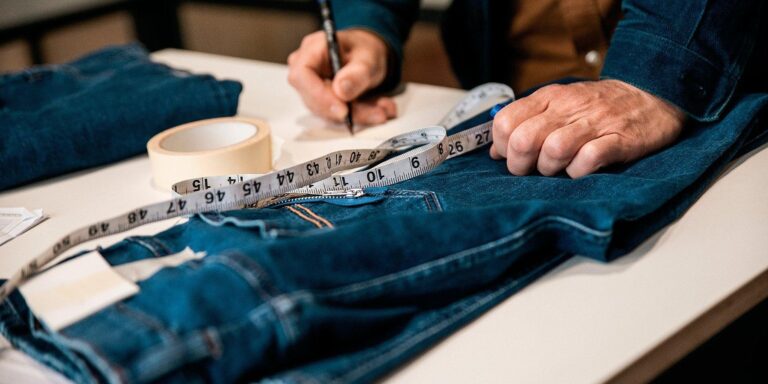
Name the base size, name each point of measure, and state a tolerance per point. A chart without named points is ambiguous: “waist” can mean the top of the waistband, the seam below it, or the relaxed circumference of the band, and on a pair of jeans those differ by several centimetres.
How a sample is measured against the chart is covered separately in evaluating a sample before bulk production.
3. Fabric
Composition in percentages, weight in both oz and GSM, and the stretch behaviour expected. “Cotton-rich denim” is a description, not a specification.
Weight alone does not describe a fabric: two 12 oz denims can differ in hand, drape and how they take a wash. The construction and finish behind those numbers are covered in denim fabric types.
4. Colour and Wash Reference
A wash reference photograph carries three variables at once — base shade, abrasion level and hand feel. If the tech pack does not say which of the three is fixed, the sample is approved against an instruction that was never written.
Splitting a reference into its parts is covered in the details to confirm before the first sample.
5. Trims, Labels and Packaging
Artwork, material, placement and size for every branded component. This section is also where lead time belongs: custom woven labels, leather patches and hardware need plates, screens or artwork approval, and that work runs on its own schedule.
6. Order Context
Quantity, size ratio, number of colours and washes, target market and required timing. These are commercial, but they change the specification: a ratio concentrated in middle sizes uses fabric differently from one spread evenly from small to extra large, and the fabric’s own minimum may rule out a colour before the garment minimum does. That interaction is covered in how MOQ is calculated.
What Usually Gets Missed
These five gaps account for most of the rework that buyers pay for:
- No tolerance. The chart lists targets but not acceptable variation, so a sample that is one centimetre off is neither clearly passed nor clearly failed.
- Points of measure left undefined. Everyone measures something reasonable and nobody measures the same thing.
- Wash priorities unstated. The reference is treated as one instruction, when it is really three that can conflict.
- Trim lead time omitted. The garment schedule assumes trims arrive on their own, and they do not.
- Size ratio missing. Grading and fabric marking are planned without knowing which sizes actually matter.
None of these is a technical problem. Each is a missing line.
Where Denim Is Different
Denim adds one complication that most other garments do not have: the wash is a second production step, and it happens after the garment is sewn.
That changes three things in the tech pack. Measurements should be specified as finished measurements after wash, not before. The wash reference needs priorities rather than a single photograph. And the tolerance has to account for the fact that the garment will change dimension once it is processed.
For a jeans-specific version of the same document, section by section, see the jeans tech pack checklist.
How the Tech Pack Moves Into Sampling
Once the document is settled, the next step is the sampling brief: which questions the sample is meant to answer, what has to be confirmed before it is cut, and what will be judged against what.
If the sample then comes back and needs changes, the tech pack is the reference for describing the correction precisely — a point of measure and a target value, not “make the fit better”.
If You Do Not Have One Yet
Most first-time buyers do not start with a finished tech pack. They start with photographs, a reference garment, or a pair of jeans they already own and consider correct.
That is workable, as long as the open items are marked as open. A brief that says “rise fixed, leg open, fabric to be confirmed” is more useful than one that appears complete and contradicts itself two pages later.
What It Changes on the Quotation
A clearer tech pack produces a quotation that can be compared, because the scope is the same on both sides. It also exposes the development cost separately from the unit cost — pattern work, sample rounds and trim setup behave differently at small volumes, which is covered in what drives jeans manufacturing costs and in comparing quotations.
Three of those sections have more detail elsewhere: grading from one base size to a full range, writing fit comments a factory can act on, and the construction details worth specifying. Each is cheap to decide in the pack and expensive to fix after cutting.
Work With BlueForm Apparel
BlueForm Apparel works with brands on private label and OEM/ODM denim development in Dongguan. A large part of that work happens before a sample is ordered: reading the tech pack, spotting the gaps, and saying clearly which details still need deciding.
If you have a tech pack that you are not confident in, or only reference images and a rough idea, send what you have. We will tell you which sections are missing and which ones can wait until the sample.
Contact BlueForm Apparel with your drawings, measurements and any reference material you already hold.
Your Next Denim Project
Let's Discuss Your Denim Requirements
Share your styles, quantities, fabric, wash and branding requirements with BlueForm Apparel. Discuss wholesale, OEM, ODM and private label options for your project.
Discuss Your Project